Uranus
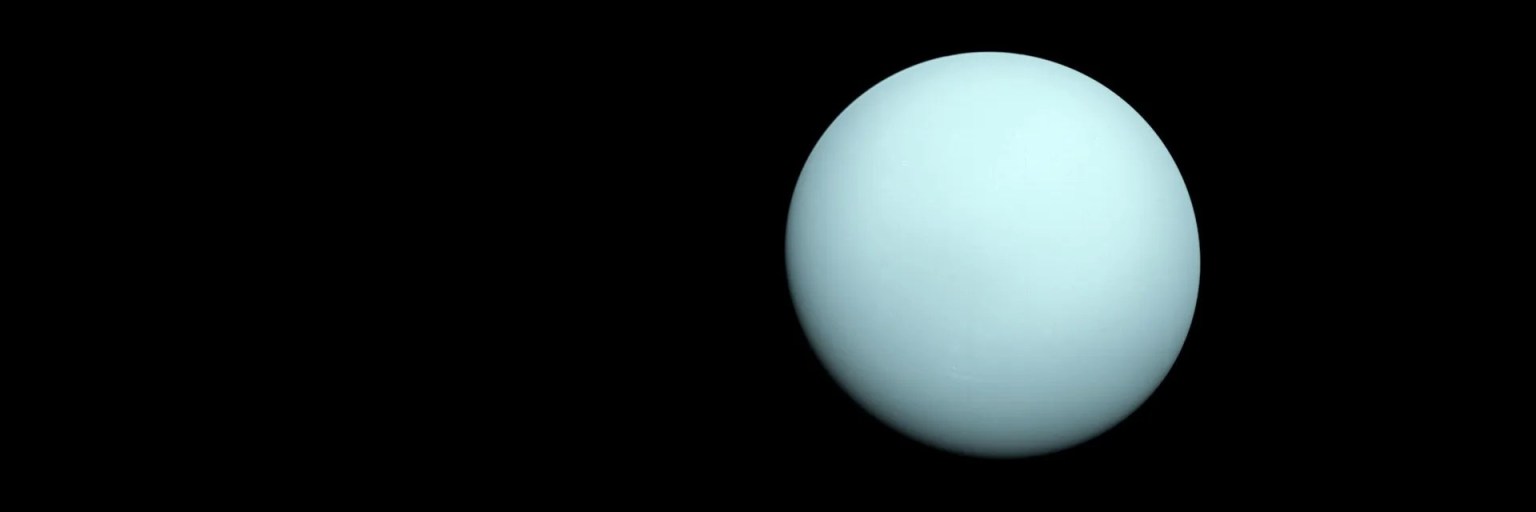
Uranus is the seventh planet from the Sun and the third largest in the solar system. It’s classified as an ice giant, with an atmosphere of hydrogen and helium plus traces of methane, which gives it a pale blue-green color. Uranus is famous for rotating almost completely on its side.
| Distance from Sun | 1.8 billion miles (2.9 billion km) — 19 AU |
| Diameter | 31,763 miles (51,118 km) |
| Length of day | about 17 hours |
| Length of year | about 84 Earth years (30,687 Earth days) |
| Moons | 28 known moons |
| Temperature | as low as -224°C (-371°F) in the atmosphere |
| Atmosphere | Hydrogen and helium, with methane and traces of water and ammonia |
Interesting facts
- Uranus rotates at a nearly 90-degree angle from its orbital plane, making it appear to spin on its side — likely the result of an ancient collision.
- Uranus’s moons are named after characters from the works of Shakespeare and Alexander Pope, rather than mythology — its five major moons are Miranda, Ariel, Umbriel, Titania, and Oberon.
- Only one spacecraft, Voyager 2, has ever visited Uranus, flying past in 1986 and discovering 10 new moons and two new rings.
- Uranus has a faint system of rings, first discovered in 1977, decades after Saturn’s rings were known.
- Despite not being the farthest planet, Uranus has the coldest atmosphere in the solar system.